Your AI Discovery Score Is Low — Here's What to Fix First
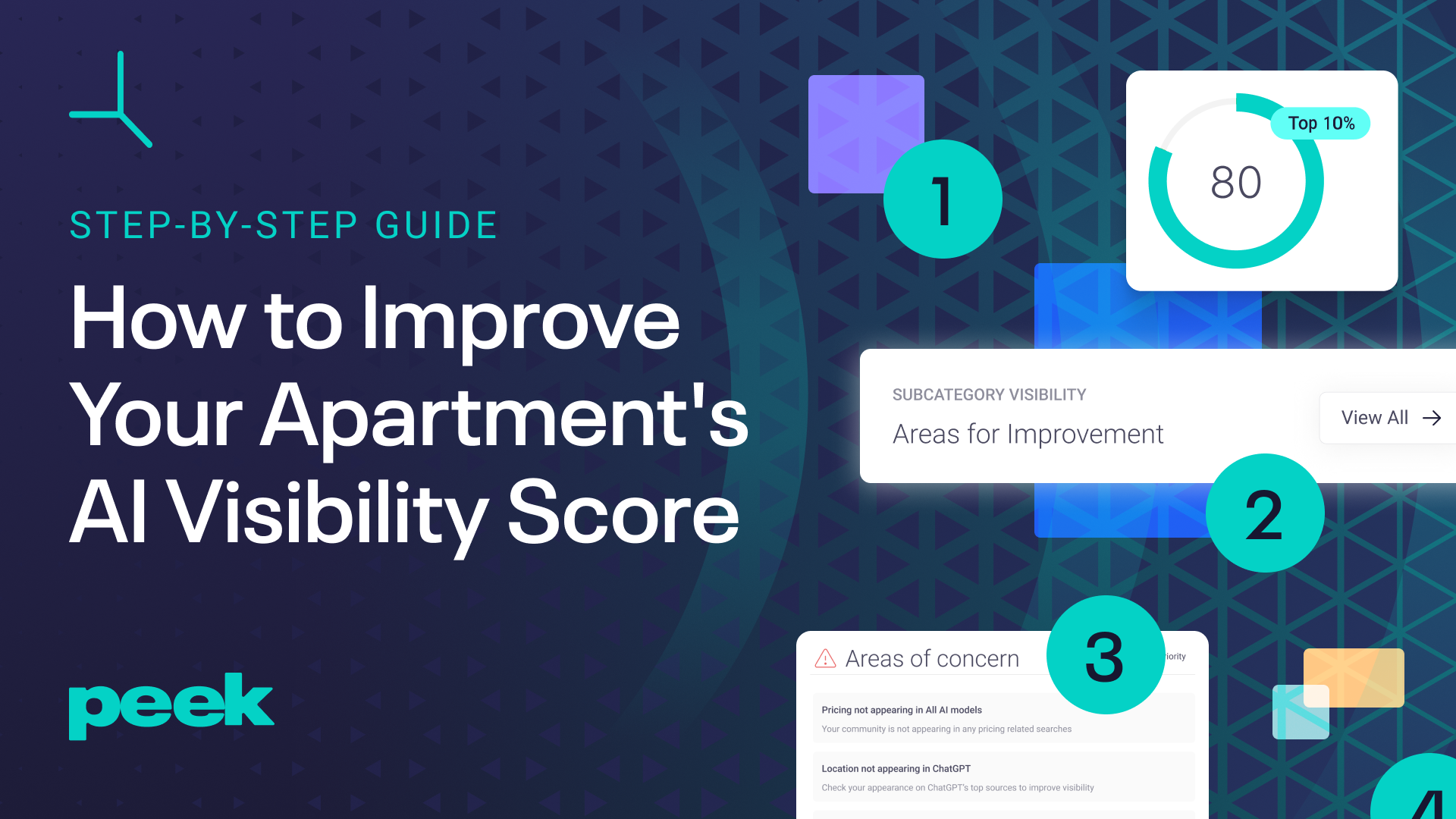
How to Improve Your Community's AI Visibility Score: A Step-by-Step Guide
More renters are using ChatGPT, Claude, Gemini, and Perplexity to find their next apartment. That means your community's AI visibility — sometimes called AEO, or answer engine optimization — is becoming as important as your Google ranking. And most operators who see their score for the first time have the same reaction: it's not where it should be.
The next question is usually "Ok, how do I fix it?" Pricing content is the single biggest lever — top performers lead by 46% on price queries, and 91% of communities underperform on price content alone. After that, it comes down to location specificity, structured data completeness, and how you write your listings.
Here's the full breakdown, based on thousands of AI visibility reports and a detailed analysis of 30 top-performing ILS listings versus mid- and bottom-tier performers.
A low score could mean a lot of different things
Your AI visibility score measures how often your community shows up when renters ask AI for apartment recommendations. It's benchmarked against nearby competitors across ChatGPT, Claude, Gemini, and Perplexity. But a low score doesn't tell you what's wrong.
Maybe your pricing data is outdated. Maybe your ILS listing is thin on neighborhood context. Maybe your property website has the right content but isn't structured in a way AI models can parse. All of these produce the same result — your community doesn't get recommended — but each one requires a different fix.
Most teams either try to fix everything at once or start with whatever feels most intuitive. Neither works well. What works is knowing where the biggest gaps are and tackling those first.
What top-performing listings actually do differently
We analyzed 30 of the top-performing communities on ILS platforms against mid- and bottom-tier performers. Five patterns stood out.
1. They get specific about location. This was the single biggest differentiator. Top performers name 40% more specific places in their descriptions, reference 3.9x more highways, and include 3.3x more transit references. They don't just list an address — they paint a picture: "a five-minute walk from the Midtown MARTA station, with direct access to the Beltline." Lower performers either skip location details or bury them in structured fields that AI models rarely surface.
2. They sound like a local recommendation, not a brochure. Top performers position their community as part of a neighborhood. Lower performers describe themselves as a product. Think "in the heart of Capitol Hill, where coffee shops meet urban trails" versus "experience luxury living with exceptional amenities." AI models are answering questions about where to live, not what to buy. The listings that sound like a friend giving advice are the ones that get cited.
3. They fill the optional structured data fields. This one surprised us. 0% of lower performers complete optional fields like views and parking on Zillow. Top performers fill them 23–40% of the time. These are free fields. They take minutes. And they directly feed the data AI uses for filtered queries like "apartment with parking near downtown." If the field is blank, your community can't match that search.
4. They describe features with specifics. Here's the counterintuitive finding: lower performers actually list more features than top performers. But they're all generic — "stainless steel appliances," "modern finishes," "spacious closets." Top performers say "Bosch dishwasher," "quartz countertops," "10-foot ceilings." When a renter asks AI for something specific, specific content wins.
5. They write differently for each platform. Top performers tailor their Apartments.com listing, Zillow listing, and property website separately. Lower performers copy-paste the same description everywhere — or worse, drop pricing disclaimers and legal language into their Zillow copy.
Beyond listing quality, our broader data shows that pricing content is the single biggest driver of AI visibility overall (46% gap on price queries, 91% of communities underperforming). Commute and location data is the second biggest lever, with a 35% gap between top performers and the rest.
Seven things to fix, in order
1. Get your pricing right everywhere. Check Apartments.com, Zillow, RentCafe, and your property website. Make sure the numbers match. Show all-in pricing where you can — renters asking AI "what does this apartment actually cost?" need a real answer, not a base rent that's $270 less than what they'll actually pay.
2. Rewrite your descriptions with real places. Name the highways, transit stops, neighborhoods, and landmarks near your community. Swap "conveniently located near shopping and dining" for "two blocks from the L train, ten minutes to the Loop, half a mile from Mariano's and the Riverwalk." This was the single biggest quality gap between top and lower performers in our analysis.
3. Fill every optional field on your ILS listings. Start with Zillow — views, parking, laundry, pet details. Then check Apartments.com and RentCafe for the same gaps. This is the easiest win on the list. Minutes of work, direct impact on AI search results.
4. Make your features specific. Swap "stainless steel appliances" for the actual brand. Swap "spacious closets" for dimensions. AI models match specific queries to specific data — generic descriptions don't give them anything to work with.
5. Stop copy-pasting across platforms. Your Zillow listing, Apartments.com listing, and property website should each be written for their context. Pull legal disclaimers out of listing descriptions. Use each platform's structured fields the way they're designed to be used.
6. Check your visibility on each AI model, not just Google. They don't all work the same way. ChatGPT leans heavily on ILS data. Claude weighs property websites more. If your ILS listing is strong but your website is thin, you'll show up on one and be invisible on another.
7. Track your score over time. AI discovery moves fast. The models update, data sources shift, and your competitors are making changes too. If you're not watching whether your fixes are actually working, you're flying blind.
Key takeaways
AI visibility comes down to giving AI models specific, structured, consistent data across every source they pull from. Pricing is the biggest single lever (46% gap). Location specificity is the biggest listing-quality differentiator (40% more places named, 3.9x more highways, 3.3x more transit). And the easiest quick win is filling the structured data fields on Zillow. Start there and your score will move.
See where your community stands
These steps work for any apartment community, but the specific priorities are different for every property. Peek Discover automates the process — testing your community against thousands of real renter prompts across every major LLM and showing you exactly what to fix first. Explore a live demo report, or book a demo to see your own community's results.
Frequently asked questions
What does an AI discovery score mean for my apartment community?
It measures how visible your individual community is when renters ask ChatGPT, Claude, Gemini, and Perplexity for apartment recommendations. A low score means you're not showing up in those conversations. The score is benchmarked against nearby competitors, so you can see whether you're ahead or behind in your specific market.
How do I improve my apartment's AI visibility score?
Start with the highest-impact gaps. Pricing content is consistently the biggest lever — 91% of communities underperform on it, and top performers lead by 46% on price queries. Location and commute data is the second biggest differentiator, with a 35% gap. Beyond that, filling structured data fields on ILS platforms (especially Zillow), writing specific rather than generic feature descriptions, and tailoring your copy per platform are the biggest quality differentiators we found in our analysis of top-performing listings.
What content do AI models use to recommend apartments?
A mix of sources: ILS listings (Apartments.com, Zillow, RentCafe), property websites, Google Business Profiles, review sites, and neighborhood databases. Each model weighs them differently — ChatGPT leans heavily on ILS data, while Claude puts more weight on property websites. The communities that show up most consistently maintain detailed, accurate content across all of these, not just one.
What is AEO for multifamily?
AEO stands for answer engine optimization. It's the practice of structuring your content so AI models can find and recommend your community when renters ask for apartment suggestions. Traditional SEO is about ranking on Google. AEO is about being the answer when someone asks ChatGPT, Claude, or Perplexity where to live. For multifamily, that means clear pricing, neighborhood-specific descriptions, and consistent data across every source AI models pull from.
How do I get my apartment to show up on ChatGPT?
ChatGPT pulls apartment data mainly from ILS platforms like Apartments.com, Zillow, and RentCafe. Make sure your listings there are complete and detailed — especially pricing, availability, pet policies, and neighborhood context. It also pulls from property websites and Google Business Profiles, so keep those consistent and up to date. Peek Discover monitors your visibility across ChatGPT and other AI models so you can see exactly where you stand.
How does Peek Discover's Report Summary Page work?
The Report Summary Page is the starting point for every Discover report. Your AI visibility score is front and center with change indicators so you can see whether you're trending up or down. Below that, your top appearances and areas for improvement are shown side by side — so you immediately see your strongest and weakest categories without digging through the full scorecard. The citations section plots every data source on a quadrant by importance versus competitive gap, and each one gets a status: maintain, monitor, priority fix, or improve. You land on the page and leave with a focused action plan.
How do I see which competitors are beating me in AI search?
Peek Discover's Top Performing Competitors feature shows which communities near yours are dominating AI recommendations, broken down by source and category. For each competitor, you get direct links to their actual content so you can see exactly what's getting them cited. A community might outperform you on pricing queries in ChatGPT but fall behind on commute prompts in Gemini — this feature breaks that down so you know where the gap is and how wide it is.