AI Apartment Search Is Shifting Faster Than We Expected | The Unlock
Google just made the biggest change to its search box in over 25 years. Ask it a question now and Gemini just answers, the way a person would, instead of handing you a list of links to scroll through.
It also launched Search Agents: bots that comb the web for you around the clock until they find exactly what you asked for. Here's how Google describes it for apartment hunting:
So if you're apartment hunting, you can brain dump all of the exact requirements you're looking for, and your agent will continuously scan for you, notifying you when listings meet your needs.
If that's how your next renters will search, how do you make sure your communities are the ones that come up? We've been tracking exactly that for five and a half months, and the data's moving faster than we expected. We dropped the first AI Discovery Black Book in March planning to refresh it quarterly, then pulled the second edition forward, on nearly double the data.
1. Top performers are winning with their own websites
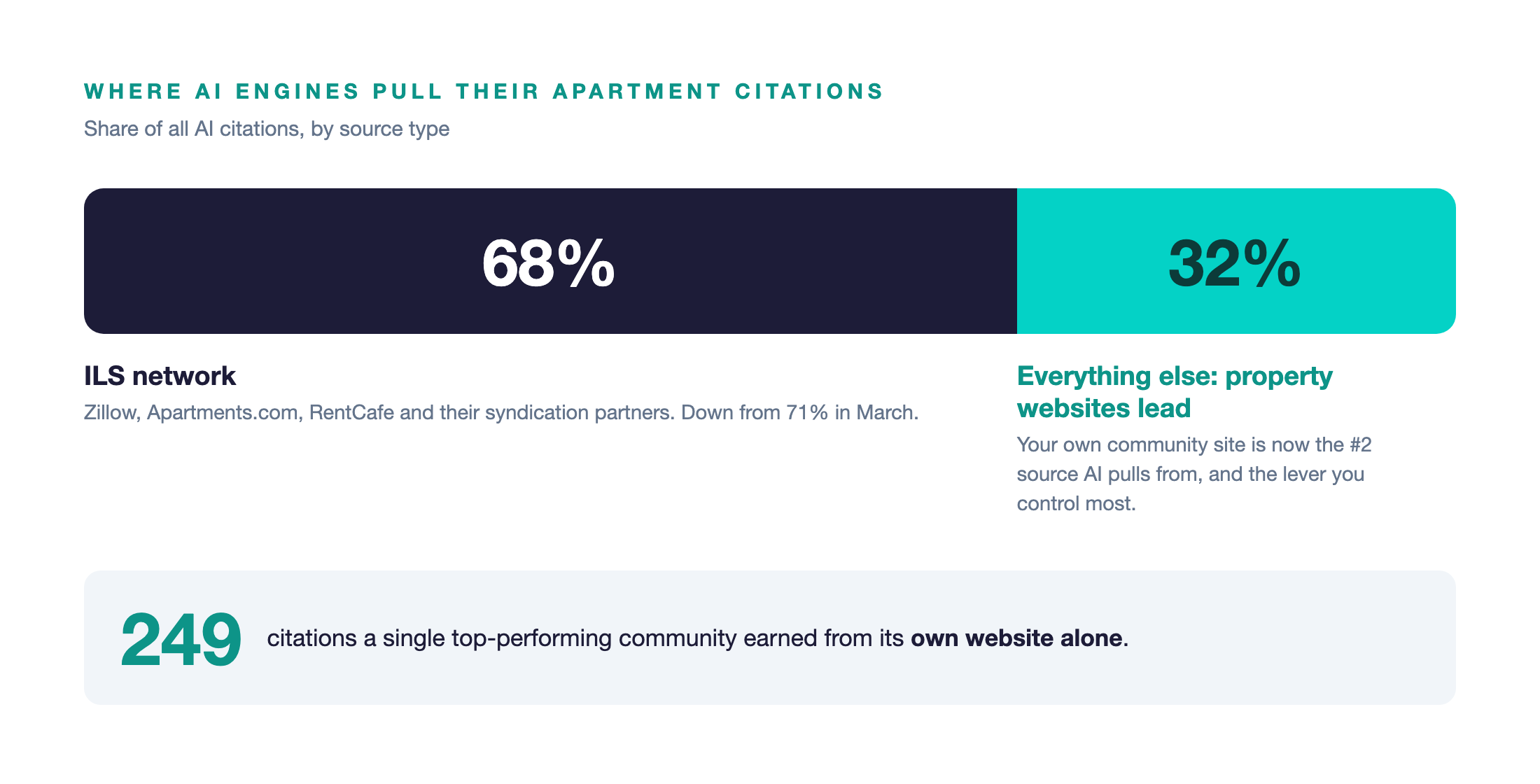
The single most interesting pattern this edition: top performers in AI discovery lean on their own websites far more than everyone else. ILSs still drive most AI citations (~68%), but operators investing in their community sites are pulling ahead: one drew 249 mentions from its site alone. Property websites are now the second most-cited source AI pulls from, and Claude and ChatGPT increasingly favor well-built ones over ILSs. Your own site is gaining authority fast, and it's the lever you control most.
2. Zillow's lead has nearly collapsed
Back in March, Zillow and its syndication partners (Trulia, Redfin, Realtor.com) drove 57% of all ILS citations AI engines pulled, a 28-point lead over CoStar. That lead is now down to 7 points: Zillow's at 45%, CoStar's at 38%.
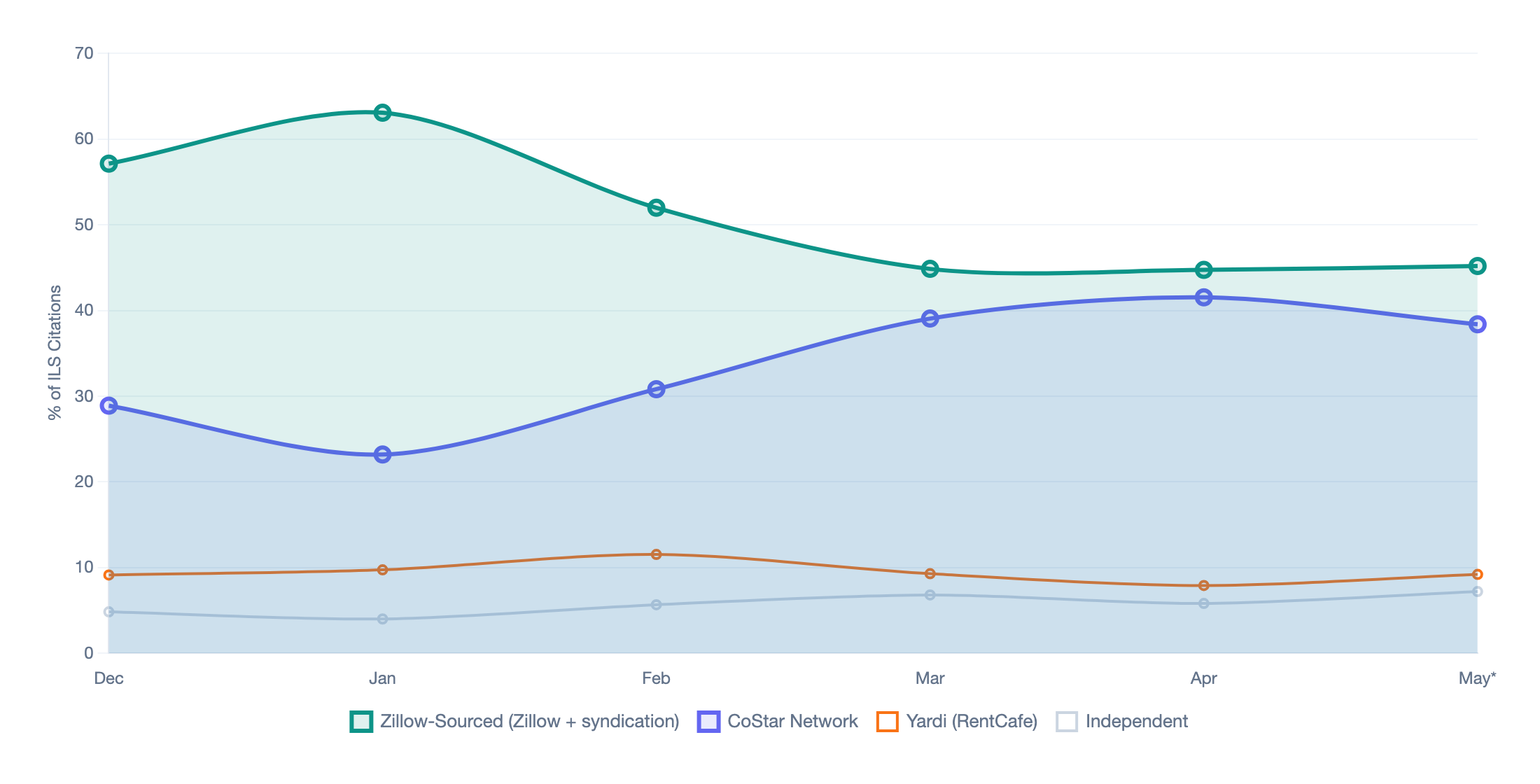
But which network is winning matters less than how many you're on. Zillow, Trulia, and Redfin all pull from the same database, so listing on all three just stocks the same product on more shelves of the same store. To spread out, pair Zillow's network with CoStar's (Apartments.com, Homes.com) and Yardi's RentCafe, which run on their own data. Zillow and CoStar alone cover about 84% of the listing-site citations AI pulls, and RentCafe gets you most of the rest. Lean on just one and you're missing half the pipeline.
3. The four major AI models are pulling apart
One playbook for all four models? Those days are over. Their reliance on listing services is all over the map: Perplexity pulls 81% of its citations from ILSs, Gemini 73%, ChatGPT 65%, and Claude just 55%.
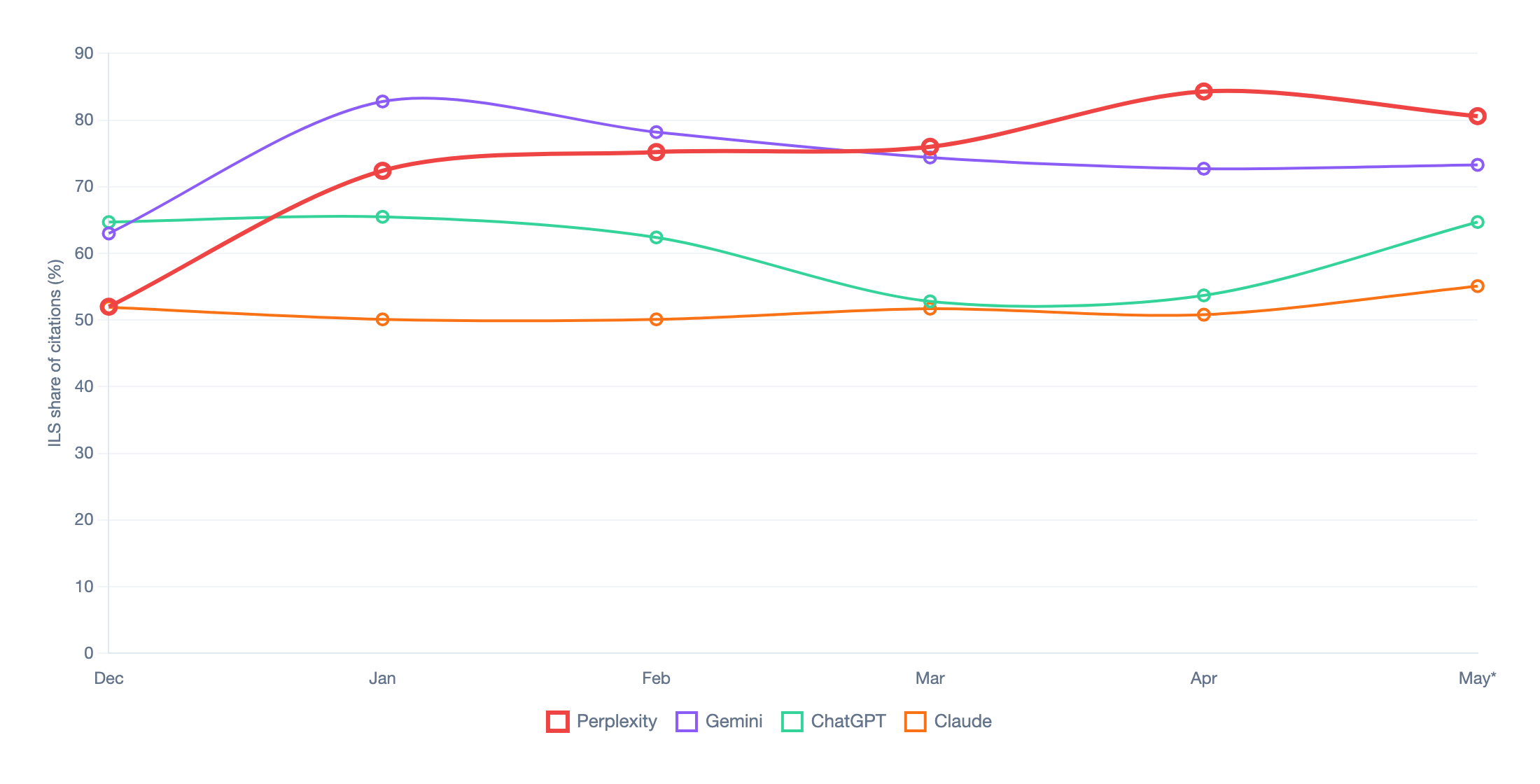
Claude is the standout opportunity. It's citing 47% more unique communities than six months ago, which makes it the easiest model to break into right now. It also leans on property websites harder than the rest, so a strong, well-built site is far likelier to surface there. ChatGPT is drifting the same way, leaning less on ILSs and more on property websites. Even within the ILSs, it's reshuffling: half as many Zillow citations as before, twice as many from Apartments.com.
4. The price-and-commute window is closing
Price and commute content still drive the biggest visibility gains, but the edge is shrinking. In March, strong pricing content gave a property a +46% lift over its competitors. Today it's +30%, and commute slipped from +35% to +26% over the same stretch.
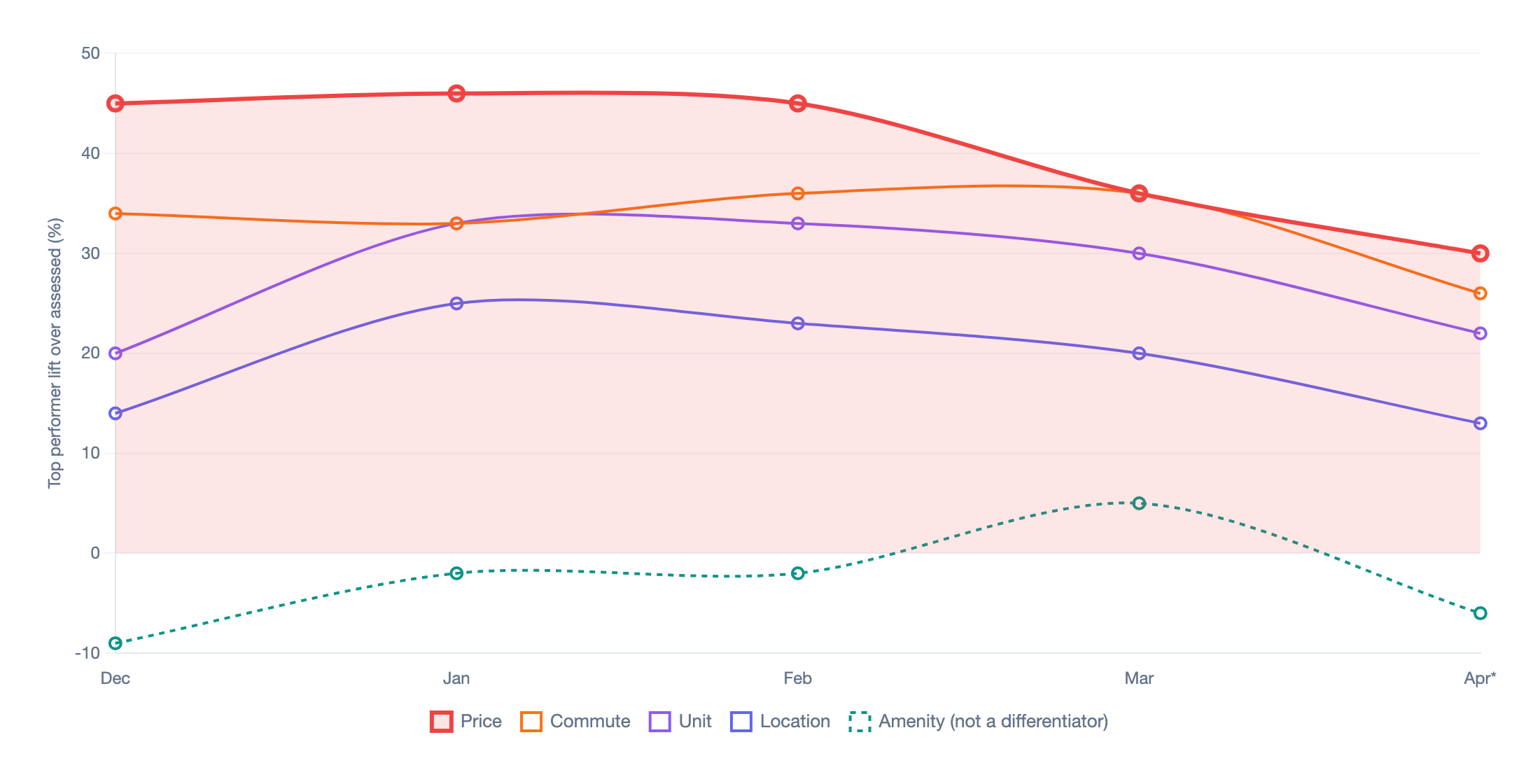
And roughly 70% of properties still miss both. Same fix, shrinking reward. Add price and commute detail now and you grab the edge before it's gone. Wait, and you're chasing a smaller and smaller one.
5. The biggest operators aren't the biggest winners
Zero of the top-10 NMHC managers beat the average community in AI discovery. As a group they average a 1.3% AI Discovery Score, against a 14.6% benchmark.
| Owner | Median MAAR | Portfolio (units) |
|---|---|---|
| Morgan Properties | 73.7% | 96k |
| Veris Residential | 71.0% | 12k |
| UDR | 64.3% | 60k |
| Equity Residential | 61.8% | 83k |
| AvalonBay Communities | 60.5% | 98k |
| Connor Group | 48.3% | 15k |
Top PMCs ranked by Median MAAR (Market-Adjusted Appearance Rate). Source: AI Discovery Black Book, 2nd edition.
We rank operators by MAAR (Market-Adjusted Appearance Rate), how visible a property is versus the best one in its own market, scored 0 to 100, so portfolios in different markets compare fairly. Scale is neither necessary nor sufficient: Morgan Properties leads at 73.7% across 96k units, while Veris Residential is right behind at 71% on just 12k. The leaderboard mixes large and small portfolios, because AI discovery is earned community by community, through accurate listings, deep site content, and broad distribution, not portfolio size.
Read the full second edition
The full Black Book has all seven findings, the website-vendor leaderboard, and the per-model playbook for ChatGPT, Claude, Gemini, and Perplexity. Read the second edition of the AI Discovery Black Book.
Want to see where your own communities stand? Pull a free AI Discovery score on any property.